

Therapy is More Than a Conversation
Therapy is more than just a conversation. It’s a delicate excavation, a peeling back of layers to reveal the raw, unfiltered experiences beneath a client’s carefully constructed surface.
As a pre-licensed therapist, you may find yourself at a crossroads—sessions are moving forward, clients are engaged, yet something feels like it’s missing. The work stays contained, skimming the edges of deeper truths, circling the same narratives without ever fully descending into them.
This isn’t about pushing. It’s about guiding. Depth-oriented therapy isn’t forcing insight but rather creating an environment where insight naturally emerges. Clients may not even realize they’re avoiding depth, just as you may not always recognize when you’re allowing them to stay in the safety of intellectualizing, storytelling, or skimming past emotion.
So how do you bring them deeper? How do you help them shift from reporting on their experiences to truly feeling them, from problem-solving to meaning-making, from circling their fears to stepping into them?
The answer lies in the questions you ask, the space you hold, and the presence you embody.
Why Clients Stay on the Surface (and Why We Let Them)
Many clients arrive in therapy conditioned to talk about their experiences rather than experience their experiences. This isn’t resistance—it’s habit. They stay in the intellectual space because it’s safe, because society has taught them that emotions must be controlled, and because sitting with discomfort feels unbearable. They may not even be aware that they are keeping themselves at arm’s length from the very insight they seek.
And then there’s us, the therapists. In our eagerness to support, we may unintentionally collude with avoidance—nodding along, asking linear questions, filling silence too quickly. Sometimes, we do it because we fear “pushing” too hard. Sometimes, it’s because we haven’t yet developed the intuitive sense of when to challenge and when to hold. And sometimes, it’s because we’re stuck in our own comfort zone of surface-level therapy.
But therapy isn’t just about comfort. It’s about truth. And truth, by its nature, is disruptive.
The Therapist’s Inner Landscape: Self-Reflection & Countertransference
Therapy isn’t just about the client’s avoidance of depth—it’s about the therapist’s too.
We enter this field with training, tools, and an earnest desire to help clients uncover their truth. But even the most skilled therapists can unknowingly shy away from depth when it treads too close to our own discomfort, biases, or past wounds.
Maybe you notice yourself steering the conversation away from a painful topic, rushing in to comfort rather than sitting in the rawness with the client. Maybe a client’s frustration stirs something in you—irritation, defensiveness, or even guilt—and before you know it, you’re subtly redirecting the session rather than leaning into the moment.
If this happens, pause and ask yourself:
- Am I avoiding discomfort in myself or the client?
- What part of me feels hesitant to explore this further?
- Is there a personal experience being activated in me right now?
This is countertransference—when our own emotions, past experiences, or unresolved wounds surface in the therapy room. And while it’s a normal, inevitable part of being a therapist, unexamined countertransference can create roadblocks to depth.
How Countertransference Can Keep Therapy at the Surface
1️⃣ Over-identification with the client.
- If a client shares something that resonates deeply with your own experience, you might unconsciously soften the challenge, worrying about their pain because it mirrors your own.
- Reflection: “Am I protecting the client from something they’re ready to face because it feels too personal to me?”
2️⃣ Avoidance of difficult emotions.
- If a client’s distress makes you anxious, you may find yourself prematurely shifting gears, problem-solving, or offering reassurance instead of letting them sit with what’s present.
- Reflection: “What emotions am I trying to bypass in this moment, and why?”
3️⃣ Emotional reactivity.
- If a client’s behavior frustrates, irritates, or overwhelms you, something deeper may be at play—a part of you that is reacting to their emotions as if they were your own.
- Reflection: “What is this bringing up in me? Is this about them, or is it about something I haven’t fully processed myself?”
Turning Self-Reflection Into a Tool for Depth
Instead of fearing countertransference, use it as a guidepost. When you notice yourself avoiding, shifting, or reacting, slow down and explore what’s happening internally:
- In the moment: Pause, take a breath, and mentally note what’s coming up for you before responding.
- After session: Take time to journal or process with a trusted supervisor—the best therapists are the ones continually doing their own inner work.
Depth-oriented therapy requires not just guiding clients into discomfort, but also sitting with our own. The more we understand our own emotional landscapes, the more fully we can hold space for others to navigate theirs.
Beyond the Words: Deepening Therapy Through Reflective Listening and Change Talk
Therapy is not just about what is said—it’s about what is meant, felt, and left unspoken. Clients often arrive in session armed with narratives they have rehearsed, stories they have told themselves (and others) for years. These stories sit neatly at the surface, polished by repetition, shaped by what feels safe to share. But beneath these explanations and intellectualized insights lies something deeper: a raw, unfiltered truth that hasn’t yet found words.
As a therapist, your role isn’t just to hear, but to listen between the lines—to reflect not only what is said but also the emotions, contradictions, ambivalence, and deeper meanings woven beneath the surface. Clients don’t always know how to access these deeper layers on their own. This is where reflective listening and complex reflections become essential tools, guiding clients toward greater self-awareness and emotional depth.
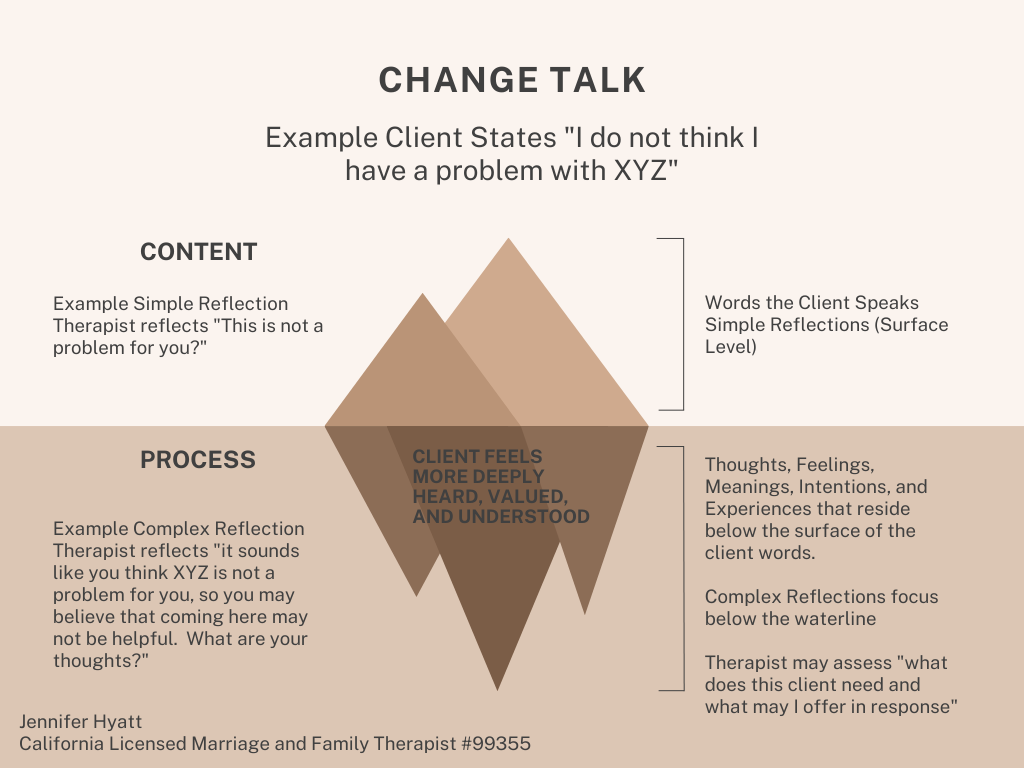
The Iceberg of Conversation: Simple vs. Complex Reflections
When a client states, “I don’t think I have a problem with XYZ,” it’s tempting to respond at face value. But in Motivational Interviewing (MI) and Reflective Listening, we recognize that words are often just the tip of the iceberg.
- Above the waterline (Content): The words the client speaks—what they consciously choose to share.
- Below the waterline (Process): The thoughts, emotions, and unspoken fears beneath the statement.
A simple reflection mirrors back content, staying at the surface:
“So you don’t see this as a problem?”
A complex reflection digs deeper, exploring why the client might hold this belief and what emotions may be present beneath the words:
“It sounds like this isn’t something you feel concerned about, and maybe that means you don’t see much of a reason to explore it further.”
This shift moves the conversation from static to dynamic, from surface to depth.
Reflective Listening: Holding Up a Mirror to the Client’s Inner World
Reflective listening isn’t passive—it’s an active skill that reshapes the client’s understanding of their own emotions. Instead of just repeating words, the therapist serves as a mirror for deeper truths.
A client might say, “I’ve been feeling off lately, but I think I’m just overreacting.”
A simple reflection might be:
“You feel a little off but wonder if you’re making too much of it.”
A complex reflection expands the emotional depth:
“It sounds like part of you is sensing that something isn’t quite right, but another part of you is dismissing those feelings before you can fully explore them.”
Complex reflections take many forms:
- Amplification: “It almost sounds like you’re trying to convince yourself it’s nothing, even though something inside you is saying otherwise.”
- Metaphor: “It’s like an itch you keep ignoring, but it hasn’t gone away.”
- Double-Sided Reflection: “A part of you feels like this is no big deal, while another part of you is wondering why this feeling keeps showing up.”
- Reframing: “Maybe this isn’t about overreacting, but about recognizing something important that’s asking for your attention.”
Each of these approaches helps move the client from thinking about their emotions to actually experiencing them.
Beyond Words: Tuning Into Body Language & Emotional Shifts
Therapy isn’t just about what clients say—it’s about how they say it, what they don’t say, and what their body is communicating in the spaces between words.
Clients may intellectualize their emotions, offering polished narratives that sound insightful but lack emotional weight. They might insist, “I’m fine,” while their hands fidget, their jaw clenches, or their voice tightens. Sometimes, the most revealing part of a session isn’t in the words spoken—it’s in the body’s quiet confessions.
Noticing Nonverbal Shifts
Rather than taking words at face value, gently bring attention to what you’re observing:
- “I noticed when you said that, your shoulders tensed. What’s happening for you right now?”
- “There was a long pause before you answered. What was going through your mind just then?”
- “You just took a deep breath after saying that. What do you notice in your body?”
By naming nonverbal cues, you offer clients an opportunity to pause, notice, and connect to emotions they may not have realized were there.
Helping Clients Move from Thinking to Feeling
For many clients, talking about emotions is different from feeling them. Body-based awareness can bridge the gap between intellectual understanding and actual experience.
If a client is detached from their emotions, you might ask:
- “Where do you feel that in your body right now?”
- “If that feeling had a texture or temperature, what would it be?”
- “What happens in your chest as you talk about this?”
Bringing awareness to bodily sensations shifts therapy from analysis to direct experience, helping clients engage more deeply with their emotions rather than just their thoughts.
When Words Fail, the Body Speaks
Some emotions defy language. Grief, shame, deep fear—these are often felt before they can be named. When clients struggle to put something into words, consider shifting the focus:
- “It’s okay if you don’t have the words yet. Let’s just sit with what’s coming up.”
- “If this feeling had a movement, what would it do?”
- “Would you be open to just breathing with this for a moment before we try to describe it?”
Therapy deepens when clients experience their emotions fully, rather than just talking about them. The body often holds the answers before the mind catches up—your role is to help clients listen to what’s already there.
The Therapist as a Tool for Deepening the Process
A therapist skilled in reflective listening and change talk does more than just respond—they guide clients into self-discovery.
Instead of questioning a client’s resistance, you hold space for it. Instead of assuming their first answer is their full truth, you listen for what’s left unspoken.
Mastering these techniques means asking yourself in every session:
- Am I staying at the surface, or am I inviting depth?
- Am I responding to what was said, or what was meant?
- Am I reflecting back words, or the unspoken emotions behind them?
True therapy begins not when a client speaks, but when we start listening beneath the words.
The Power of Silence: Creating Space for Depth
Therapy often leans on words—on carefully chosen reflections, skillful questioning, and verbal exploration. But silence? Silence can feel unsettling. It lingers, stretches, and exposes what isn’t yet spoken. Yet, when used intentionally, silence is one of the most powerful tools for deepening therapy.
Many clients (and even therapists) instinctively rush to fill silence, fearing it signals awkwardness, disconnection, or a lack of progress. But in reality, silence is an invitation—a moment where clients can truly sit with their emotions rather than escape into words.
When Silence Speaks Louder Than Words
Imagine a client shares a painful memory and then immediately moves on:
“Yeah, that was tough, but I don’t really think about it much anymore.”
The easy route would be to follow their lead—to let the conversation move forward without dwelling. But if you pause, if you allow the silence to settle without rushing to respond, something different happens.
Instead of filling the gap, you hold it. You watch. You wait.
And often, the client will do something remarkable: they will speak again, but this time from a deeper place.
They might shift in their seat, sigh, or glance away before finally admitting, “Actually… I do think about it. More than I want to.”
That silence? That was the moment the real work began.
How to Use Silence to Deepen Therapy
Silence isn’t just an absence of speech—it’s an active intervention. The key is to use it with intention rather than discomfort.
Here’s how:
1️⃣ Let silence breathe. After a client shares something meaningful, resist the urge to immediately respond. Count to five in your head before speaking. Give them space to process.
2️⃣ Notice what shifts. Watch the client’s body language. Does their breath change? Do they suddenly fidget or look away? Their discomfort might be revealing something deeper that words alone wouldn’t uncover.
3️⃣ Bring gentle awareness to the pause. If a client seems caught in a silent moment, you can reflect it back:
- “I noticed you got quiet just now. What’s happening for you in this pause?”
- “There was a shift just then—what are you feeling in this moment?”
4️⃣ Normalize discomfort in silence. If a client rushes to fill the space with surface-level talk, gently highlight the pattern:
- “I wonder if the silence felt a little uncomfortable just now. Sometimes when we sit with things, they start to feel bigger. Let’s stay with this for a moment.”
Silence as an Act of Trust
Silence isn’t about withholding—it’s about offering space for something deeper to emerge. It signals to the client:
“I’m not afraid of this moment. I trust that something meaningful is here, and I trust you to find it.”
When used well, silence becomes a doorway—one that allows clients to step into parts of themselves they might not have known were waiting.
Now that we’ve explored the role of silence, let’s look at the kinds of questions that open deeper doorways for clients
The Art of Deepening Therapy: Moving from Surface to Depth
To deepen therapy, you must ask differently. You must create doorways where before there were only walls. Instead of asking, “What happened?”, you might ask,
- “What meaning have you made of that experience?”
- “What did that moment tell you about yourself?”
- “If we slowed this down, what do you notice happening in your body as you recall it?”
Questions like these shift the focus from the facts of the story to the impact of the experience.
Clients don’t need to be forced into depth; they need to be invited. The right invitation allows them to step toward it at their own pace. Depth emerges naturally when you create the conditions for it.
Let’s explore five therapeutic approaches that naturally expand the conversation: Acceptance and Commitment Therapy (ACT), Motivational Interviewing (MI), Internal Family Systems (IFS), Existential Therapy, and Jungian Shadow Work.
ACT – Moving Beyond Intellectual Insight
ACT helps clients untangle from rigid narratives and break free from emotional avoidance. Many clients believe that before they take action, they must first feel better, gain confidence, or resolve their distress. ACT challenges this assumption by teaching that action comes first—clarity follows.
A client caught in anxiety might say, “I just need to stop overthinking before I can make a decision.” Rather than debating this belief, you might lean into ACT’s approach:
“What if clarity isn’t a prerequisite for action? What if the next step can happen even in the presence of doubt?”
If a client is deeply fused with their thoughts, convinced that their self-critical voice is an absolute truth, you can guide them into defusion:
“It sounds like your mind has built a really strong story about what this means for you. If we imagined that thought as a radio station playing in the background, how loud is it right now? What happens if you turn the volume down just a little?”
Motivational Interviewing – Unpacking Ambivalence
Change is rarely a straight path. Clients may express the desire to grow while simultaneously digging their heels in the sand. This isn’t failure—it’s ambivalence, and it holds valuable information.
Instead of trying to convince a client that they should change, MI asks us to explore:
- “What’s the best thing about staying the same? What’s the hardest thing?”
- “What part of you is ready for change, and what part of you is afraid?”
By normalizing ambivalence, you allow the client to see their hesitation not as a roadblock but as a message from a part of themselves that needs attention.
If a client is stuck, unsure whether to move forward, you might say:
“It makes sense that one part of you is saying, ‘I need to do this,’ while another part is saying, ‘I’m not ready.’ What do both parts need in order to move forward?”
Internal Family Systems – Uncovering the Hidden Voices
IFS shifts the conversation from self-judgment to self-inquiry. When clients say, “I don’t know why I keep sabotaging myself,” or, “I hate that I always do this,” they are usually speaking from a blended state—a moment where they are fully fused with a part of themselves that they don’t yet understand.
Rather than pathologizing, IFS teaches that every “stuck” part has a purpose. It is trying to protect something, even if it’s going about it in a dysfunctional way. Instead of asking, “Why do you do that?”, invite the client into curiosity:
“If this part had a voice, what would it say?”
“What does this part believe it’s protecting you from?”
If a client is struggling with self-criticism, you might say:
“That critical voice—does it remind you of anyone? Is it echoing something you’ve heard before?”
By externalizing the struggle, clients gain space between who they are and what they feel.
Existential Therapy – Asking the Bigger Questions
Existential therapy invites clients to confront the questions beneath the questions. It moves beyond symptom management and into the realm of meaning, identity, and purpose.
If a client is feeling lost, unsure of who they are outside of a role they’ve been given, you might ask:
“If you stripped away all the expectations and roles you’ve been given, who would you be?”
For clients searching for purpose, reframing the question can be powerful:
“What if meaning isn’t something you find, but something you create?”
By shifting from seeking to creating, the client steps into agency over their own narrative.
Jungian Shadow Work – Exploring What’s Hidden
Jungian work asks: What parts of yourself have you rejected?
Many clients struggle with projection, feeling intense emotions toward others without realizing the deeper reflection within. If a client is triggered by someone’s confidence, you might ask:
“What about their confidence is unsettling to you? Is it possible that this is a part of you that you haven’t fully allowed yourself to embrace?”
Shadow work isn’t about eliminating these hidden parts—it’s about integrating them.
Grounding Through Depth: A Quick Re-Centering Tool
Deep emotional work can stir powerful reactions—grief that feels like a tidal wave, anger that surges unexpectedly, memories that surface before a client is ready. Depth doesn’t always come gradually; sometimes, it erupts. And when it does, a client may shut down, disconnect, or become overwhelmed.
As therapists, our role isn’t just to guide clients deeper—it’s also to help them stay present in the experience without feeling like they’re drowning in it.
Helping Clients Stay Grounded in the Moment
If you sense a client becoming emotionally flooded or disconnected, a simple grounding practice can help them reorient to the present so they feel safe enough to continue.
Try this three-step approach:
1️⃣ Pause and slow the pace.
- Instead of continuing forward, acknowledge what’s happening in real-time:
- “I notice this is bringing up a lot for you. Let’s take a breath together before we continue.”
2️⃣ Engage the senses.
- Helping clients anchor to the present moment can prevent them from spiraling into past trauma or future fears:
- “Can you tell me one thing you see, one thing you hear, and one thing you feel physically right now?”
3️⃣ Offer choice.
- Depth isn’t about pushing through discomfort—it’s about holding space for it in a way that feels manageable.Give clients a sense of agency:
- “Would it feel helpful to explore this right now, or would you like to take a moment before we continue?”
Grounding as a Bridge to Depth, Not an Escape
Some therapists worry that grounding might interrupt the therapeutic process or prevent deep exploration, but the opposite is true. Grounding isn’t avoidance—it’s regulation. A client who feels safe in their emotions is more likely to stay engaged and process deeply rather than dissociate or withdraw.
The goal isn’t to pull the client out of the experience—it’s to help them stay with it in a way that feels tolerable. Depth is most effective when clients feel supported, safe, and in control.
Depth as a Therapist’s Superpower
Depth-oriented therapy is about inviting the unspoken, allowing the unresolved, and making room for what’s been hidden. It’s about trusting that the client already holds the answers—your job is to ask the questions that help them see it for themselves.
But depth isn’t about forcing insight—it’s about creating the conditions where it naturally emerges. It’s about being willing to sit in discomfort, to slow down when urgency takes over, and to trust that transformation happens not in neatly packaged revelations, but in the quiet moments where something unspoken finally finds room to emerge.
As therapists, our role is not to push clients deeper, but to stand at the threshold with them, holding the lantern, and saying, “I’m here. Let’s step in together.”
So, what’s one question you can bring into your next session to invite deeper exploration?
Taking Depth-Oriented Therapy Further: A Practical Handout for Clinicians
Guiding clients beneath the surface isn’t always intuitive—it requires a thoughtful blend of presence, curiosity, and strategic questioning. While this blog has explored the principles behind depth-oriented therapy, sometimes having concrete tools at your fingertips can make all the difference in the moment.
To support this work, I’ve created a Depth-Oriented Therapy Questions Handout, offering a collection of carefully curated questions categorized by therapeutic orientation. This handout provides practical prompts designed to help you:
✅ Move beyond surface-level conversations and into deeper emotional exploration.
✅ Support clients who intellectualize, avoid, or struggle to access their emotions.
✅ Guide discussions in alignment with different therapeutic frameworks, including ACT, IFS, Motivational Interviewing, Existential Therapy, Jungian Shadow Work, and more.
✅ Use silence, reflective listening, body awareness, and grounding to help clients stay present during deep work.
If you’ve ever found yourself searching for the right question to help a client tap into something deeper, this handout will give you a structured yet flexible resource to invite exploration without force.
Depth is a process, not a destination—and sometimes, the most powerful work happens when we ask the right question and trust what unfolds.
🔹 [Click here to access the Depth-Oriented Therapy Questions Handout]
Written by Jen Hyatt, a licensed psychotherapist at Storm Haven Counseling & Wellness in Temecula, California.
This blog post is intended for informational and educational purposes only and reflects the author’s perspectives and experiences as a mental health professional. It is not a substitute for formal training, supervision, or individualized clinical guidance. Therapists are encouraged to consult their own professional resources, supervisors, or peers when applying concepts to their practice.





 The Nerdie Therapist
Leave a comment