
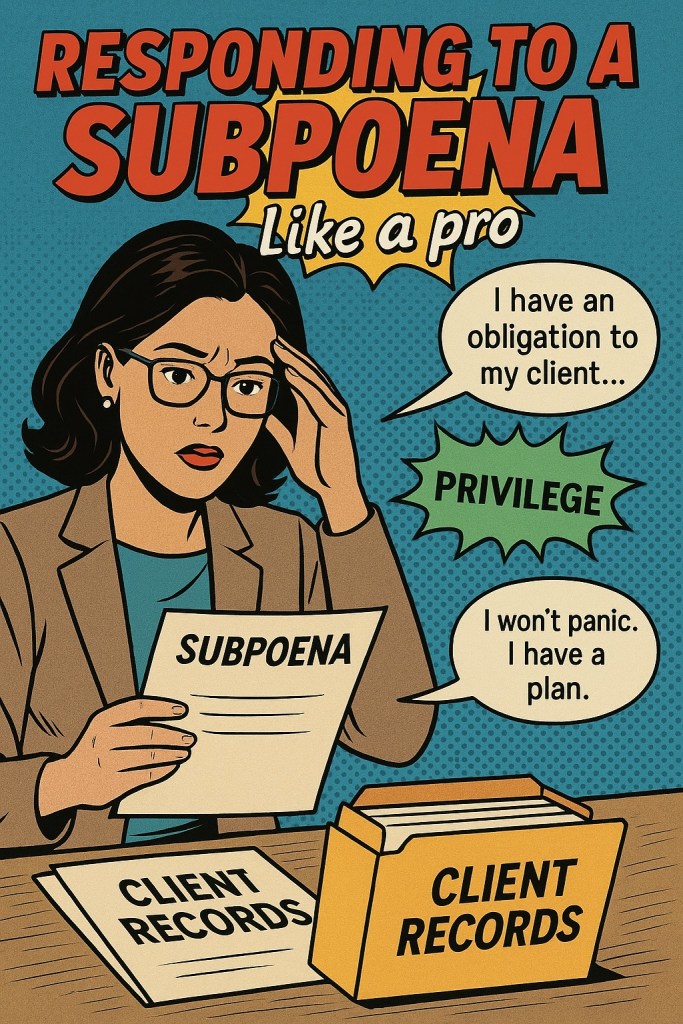
The Jump Scare of Private Practice
There are certain rites of passage in a therapist’s career that no one really prepares you for. Your first intake that runs forty minutes over because the story just kept unfolding. Your first client who vanishes mid-treatment plan with no closure and a mysterious “new number.” And then—your first subpoena duces tecum.
That’s Latin for “you shall bring with you,” which sounds like something whispered at the gates of the underworld but actually means: someone wants your records.
It usually arrives on crisp letterhead with intimidating fonts and the sort of formality that makes even the most ethically grounded therapist briefly forget every law, boundary, and deep-breathing technique they’ve ever learned. The heart rate spikes, the mind races, and the first thought is almost always, “Am I in trouble?”
Here’s the good news: you’re not. Receiving a subpoena doesn’t mean you did something wrong—it means the legal system has entered the group chat. At some point in your career, if you work long enough and keep accurate notes, you’ll get one. It’s not a reflection of your competence; it’s a reflection of how therapy and law occasionally brush shoulders in awkward, bureaucratic ways.
This post is your permission slip to exhale. We’re going to decode what a subpoena duces tecum actually is, what to do (and not do), and how to protect both your client and your peace of mind while maintaining professional integrity. Because panic is optional—but preparation is not.
What It Actually Means (Spoiler: You’re Not Being Sued)
Let’s translate the Latin before your nervous system translates it into existential dread.
A subpoena duces tecum is a legal request for documents—specifically, your client’s records. It’s the court’s way (or sometimes an attorney’s way) of saying, “Hey, can we see your stuff?” It doesn’t accuse you of wrongdoing, and it doesn’t mean you’re part of the lawsuit. You’re simply the keeper of information someone believes is relevant to their case.
Here’s where therapists tend to freeze: it looks like an order, but not all subpoenas carry the same weight.
- If it’s signed by an attorney (and not a judge), it’s basically a formal ask—a request that must still pass through the filter of confidentiality. You are not required to hand over anything without client authorization or a court order.
- If it’s signed by a judge, it carries legal authority. That means you generally must comply—but you can (and often should) request limits, redactions, or a protective order to ensure privacy is maintained.
In both cases, your role isn’t to play detective or defense—it’s to safeguard your client’s confidentiality while following the law.
Think of it like this: the legal system and the mental health system speak two entirely different languages. The subpoena is the legal system knocking on your office door. You get to decide, based on ethics and process, whether to open the door fully, crack it an inch, or politely ask for the proper paperwork first.
🧠 Nerdie Note: “Subpoena” literally means under penalty. But here’s the thing—the penalty only applies if you ignore it completely. You can (and should) acknowledge receipt while you confirm whether disclosure is appropriate. You’re not stonewalling; you’re practicing ethical discernment.
So, before panic clicks “reply all,” pause. You’re not in trouble. You’re being asked to play the role of professional guardian. And if there’s one thing therapists excel at—it’s protecting the sacred boundaries of trust.
Pause, Don’t Panic: The Legal Nervous System Response
There’s a particular flavor of adrenaline that only therapists know: the legal adrenaline rush. It’s that strange cocktail of panic, professionalism, and the sudden urge to reread your graduate ethics textbook.
When that subpoena lands in your inbox, your nervous system doesn’t know it’s about paperwork—it thinks you’re being chased by a saber-toothed cat wearing a judge’s robe. Cue racing thoughts:
Did I miss something? Am I being sued? Is this because of that one late progress note in 2018?
Pause. Breathe. You’re not in trouble. You’re in process.
What you’re feeling is your body doing its job—responding to threat. But in this case, the “threat” isn’t an ethical crisis, it’s an administrative one. The task isn’t to react; it’s to regulate. Before you call anyone or open any attachments, do what you teach your clients: ground, orient, and gather information.
Here’s the truth: the legal system runs on procedure, not panic. The moment you treat the subpoena as a request for verification rather than a personal accusation, everything slows down.
🧭 Therapist Translation: The same skills you use in session—containment, curiosity, and boundaries—apply here too. You contain your initial anxiety, get curious about what’s being asked, and hold firm to your ethical boundaries until you understand your obligations.
If you respond reactively—sending records too soon or ignoring the request entirely—you risk either a confidentiality breach or a contempt notice. Neither is fun. The middle path is simple acknowledgment, patient verification, and documentation.
So, pour some coffee, take that deep, slow breath you recommend to clients, and remind yourself: you’ve got this. Your job isn’t to play attorney; it’s to play steady clinician in a system that thrives on paperwork and precision.

Step-by-Step: How to Respond Without Leaking PHI or Losing Sleep
Now that your heart rate has re-entered a reasonable range, let’s walk through the actual process. Think of this as your therapist survival manual for when law meets the limbic system.
Step 1: Verify Before You React
Before you do anything, check whether the subpoena is legitimate.
- Who signed it — an attorney or a judge?
- Is your name or your practice actually listed?
- Does it give a response deadline that makes sense?
If it’s from an attorney only, remember: this is a request, not a royal decree. You are not obligated to release records until you have either a client’s written authorization or a court order. Verification first—panic later (preferably never).
Step 2: Assert Privilege and Notify Your Client (or Their Attorney)
Confidentiality still belongs to the client. When you receive a subpoena, your first ethical move is to assert psychotherapist–patient privilege—that’s your client’s legal right to keep their therapy information private.
This can be noted internally as:
“Records requested are privileged and confidential. Privilege is asserted on behalf of the client pending direction from the client or the court.”
Then, notify your client (or their attorney, if they’re represented) that a subpoena has been received. Ask whether they wish to release the records or maintain privilege.
If they choose release, obtain a specific, signed Release of Information (ROI) that names the requesting party, purpose, and scope.
If they choose to maintain privilege, no records are released—and you continue to protect confidentiality on their behalf.
💡 Even if no records are being released, it’s best practice to obtain a Release of Information before responding in any way to the requesting party.
Why? Because even acknowledging that someone is (or was) your client confirms protected health information under HIPAA. The ROI allows you to communicate within legal and ethical bounds, ensuring that you’re not breaching confidentiality just by replying.
Step 2½: If the Client Is Not Reachable
Sometimes the client is long gone—moved, changed numbers, or simply hasn’t been seen in months. If a subpoena arrives and you’ve made reasonable, documented attempts to contact the client (voicemail, email, certified letter, etc.) and there’s a timeline to respond, here’s what to do:
- Do not release records unless ordered by a judge.
- Continue to assert privilege on behalf of the client until directed otherwise by the court.
- Document every attempt to reach the client and any communications you made to verify privilege.
If the response deadline approaches and you still cannot reach the client, your attorney or risk manager can respond on your behalf. The language should acknowledge receipt of the subpoena without confirming any client relationship or releasing information.
For example, your attorney might write:
“This office represents [Therapist’s Name]. The subpoena has been received. At this time, no authorization for release of information has been obtained, and psychotherapist–patient privilege is being asserted pending further court direction.”
This kind of response fulfills procedural requirements without exposing protected health information or confirming who the client is.
If the court then compels you to appear or produce records, your attorney can request a protective order or in-camera review (private judicial review) to ensure confidentiality is maintained.
This approach protects client privacy, demonstrates due diligence, and shows that you’ve complied with the legal process appropriately—even in the client’s absence.
In your chart, note: “Subpoena received [date]. Attempts to reach client unsuccessful. Privilege asserted pending court direction.”
💡 Nerdie Note: “Unable to reach client” is not the same as “permission to disclose.” When in doubt, privilege stands—and counsel speaks for you.
Step 3: Consult Before You Comply
Once privilege is asserted and the client’s wishes are clear, reach out to your professional liability carrier (most provide free subpoena consultations) or an attorney familiar with mental-health law in your state.
They’ll review the subpoena’s validity, help you meet the proper deadlines, and guide you on what—if anything—needs to be sent. You don’t need to navigate this maze solo.
Step 4: Hold All External Responses Until Everything Is Settled
Do not communicate directly with the requesting attorney until:
- You’ve verified the document’s legitimacy,
- Consulted legal counsel, and
- Received either a client release or a court order.
Premature communication—even a polite acknowledgment—can inadvertently confirm protected information (like the existence of a therapeutic relationship).
Once all steps are complete, you may issue a final written response if required. Keep it brief and factual—no extra details, no narrative, no justifications. For example:
“Pursuant to the client’s signed release of information, all authorized records have already been provided. There are no additional records to be released.”
or
“At this time, the psychotherapist–patient privilege is being maintained on behalf of the client, and no records will be released absent further legal authorization.”
Step 5: Document Everything
Write a concise administrative note in the client’s chart:
- Date received
- Who requested
- Actions taken (asserted privilege, notified client, consulted counsel)
- Whether or not records were released
File the subpoena and your final response securely in the administrative section of the record—not with clinical notes. Future-you will sleep better knowing everything’s documented.
💡 Nerdie Reminder: Asserting privilege isn’t defiance; it’s ethical backbone. You’re not ignoring the system—you’re ensuring the system respects the sanctity of the therapy room.
Following these steps keeps you inside the lines of HIPAA, your licensing board, and your professional ethics, all without accidentally sending PHI on a premature reply-all.
Additional Guidance for Therapists
Even when you’ve followed every step to the letter, some situations call for extra clarity or professional backup. Think of this as the final boss level of therapist paperwork—less panic, more precision. These notes help you stay grounded in both ethics and law when the subpoena storm rolls in.
⚖️ When to Seek Immediate Legal Guidance
Even the most seasoned therapist shouldn’t navigate every subpoena solo. Some situations call for professional backup—stat. Reach out to your liability carrier or an attorney familiar with mental health law right away if:
- The subpoena or order is signed by a judge rather than an attorney.
- You’re being asked to testify or appear in court in addition to producing records.
- The subpoena demands original records, not copies (this may violate your retention policy).
- You suspect releasing the requested information could harm the client or breach third-party confidentiality.
- The subpoena conflicts with other legal duties (for example, mandated reporting or custody laws).
These are not “figure it out yourself” moments—they’re phone-a-friend moments. An attorney can help you assert privilege correctly, negotiate the scope of disclosure, and ensure you don’t accidentally hand over more than required.
💡 Nerdie Reminder:
You don’t lose professionalism by seeking counsel—you demonstrate it. Knowing when to call your attorney is as essential as knowing when to consult on a complex clinical case.
🧠 In Your Chart
When documenting, keep your administrative note short and factual. For example:
“Subpoena received [date]. Attempts to reach client unsuccessful. Privilege asserted pending court direction.”
This concise note protects both you and your client, showing that you acted diligently without editorializing.
💡 Nerdie Note: Future-you will thank past-you for keeping it clear and clinical.
🪞 Reflection for the Road
Therapy may live in the realm of emotions, but private practice occasionally wanders into the land of legalese. Knowing how to respond—calmly, ethically, and with privilege intact—turns a potential crisis into a professional rite of passage.
You can’t control the paperwork that lands on your desk, but you can control your pace, your process, and your professionalism.
What to Actually Say (Scripts You Can Steal)
Let’s be honest—when you’re standing between confidentiality and a looming legal deadline, it helps to have the words ready. Here are some sample scripts you can keep on file for the moments when your brain wants to flee the scene but your ethics require composure.
These scripts assume you’ve already:
- Verified the subpoena’s legitimacy,
- Asserted privilege,
- Consulted with your client (or their attorney),
- Talked with your own legal counsel or liability carrier, and
- Either received direction to release, to assert privilege, or to close the loop with a formal reply.
If the Client Chooses to Maintain Privilege
Use this once your attorney advises you to issue a written statement (or issues it on your behalf):
“At this time, the psychotherapist–patient privilege is being maintained on behalf of the client. No records will be released absent further legal authorization or court order.”
Short, clear, final. It communicates that privilege stands—no further details necessary.
If the Client Authorizes Release (and You’ve Sent the Records)
“Pursuant to the client’s signed Release of Information, all authorized records have already been provided. There are no additional records to be released.”
This statement is concise and complete—no explanation, no defense, just documentation of closure.
If the Client’s Attorney Already Received the Records
Sometimes the client’s own legal counsel has already been given the complete record under an existing release. In that case, your attorney (or you, once advised) can use clear language that confirms fulfillment without new disclosure:
“Pursuant to the client’s signed Release of Information, all authorized records have already been provided to the client’s legal counsel. There are no additional records to be released.”
This clarifies that you’ve complied fully with the original authorization, prevents unnecessary duplication, and keeps privilege intact for any further requests.
If the Client Cannot Be Reached and You’ve Asserted Privilege
This language would typically come from your attorney or risk manager to avoid disclosing client status:
“This office represents [Therapist’s Name]. The subpoena has been received. At this time, no authorization for release of information has been obtained, and psychotherapist–patient privilege is being asserted pending further court direction.”
This protects privilege and ensures procedural compliance, without confirming the identity of any client.
If the Court Issues a Signed Order
Once a judge signs an order directing disclosure, you may be legally required to release certain records—but you can still advocate for limitations. Your attorney may include or request language such as:
“Pursuant to court order dated [insert date], the following materials are provided. Disclosure has been limited to information specifically required by the court.”
This ensures your compliance stays inside the exact legal boundary—nothing more, nothing less.
If Asked for Testimony or Verification Without Authorization
Sometimes attorneys push for confirmation that someone is or was your client. You can (and should) decline to answer without a release or court order. Your counsel might phrase it as:
“Without appropriate authorization or court order, [Therapist’s Name] cannot confirm or deny any therapeutic relationship or the existence of records.”
It’s professional, ethical, and entirely within your rights.
💬 Nerdie Reminder:
You don’t owe anyone a long explanation. You owe your clients confidentiality, your license compliance, and your own peace of mind. Every word you send should either serve due process or protect privilege—nothing in between.
The Law, Ethics, and Therapy Intersection
The moment a subpoena crosses your desk, it can feel like two worlds colliding: the slow, reflective cadence of therapy and the brisk, procedural rhythm of law. One lives in nuance and narrative; the other thrives on precision and proof. It’s no wonder therapists sometimes feel caught between galaxies.
Here’s the secret: law and ethics aren’t adversaries—they’re the twin guardrails of your professional lane. The legal system sets the external boundaries, while ethics hold your internal compass steady. Both are designed to protect the same thing: your client’s right to privacy and your integrity as their clinician.
When you assert privilege, you’re not obstructing justice—you’re protecting process. The court can’t evaluate whether records should be released unless someone first asserts that those records deserve protection. That’s your role in the ecosystem: guardian of the confidential, not enemy of the court.
The Triangle of Protection
Think of this like a three-point alliance between:
- Law – defines the structure (court orders, subpoenas, HIPAA).
- Ethics – defines the soul (AAMFT, NASW, ACA, APA, state boards).
- Clinical Judgment – connects the two (your human discernment).
Each must be consulted before a single page leaves your office. When these three align, you can act decisively without anxiety because your reasoning is grounded in both legal precedent and professional ethics.
The Therapist’s Role: The Calm in the Crossfire
Our work already carries the weight of people’s stories. When the legal system enters, those stories risk becoming exhibits.
Your steady presence—and your clear ethical stance—remind everyone involved that therapy is not a transaction; it’s a protected process of healing.
That’s why privilege exists: to safeguard vulnerability from becoming evidence unless absolutely necessary. You don’t have to love legal paperwork to recognize the sacredness it’s trying (sometimes clumsily) to preserve.
🧭 Nerdie Reflection:
When law and ethics intersect, think of yourself as the translator at the border. The law speaks in statutes; ethics speaks in values. You, therapist, are fluent in both human and procedural language.
The goal isn’t to “win” against the legal system—it’s to honor confidentiality while cooperating responsibly. You can be both cooperative and protective. That balance is what transforms an overwhelmed clinician into a confident professional.
The Aftermath: Debriefing Your Own Nervous System
Even when everything goes smoothly—privilege asserted, counsel consulted, client informed—your nervous system might still feel like it just ran a marathon in business casual. Legal interactions can stir up an ancient cocktail of fear, self-doubt, and cortisol that no amount of grounding stones or tea can fully erase on the first try.
So, before you rush into your next session pretending you’re unbothered, take a moment to check in with yourself. This wasn’t just paperwork; it was a test of your ethical and emotional endurance.
Normalize the Come-Down
When the legal adrenaline fades, the therapist’s brain often fills the silence with self-interrogation: Did I say the right thing? Did I protect the client enough? Did I sound competent to that attorney?
You did. You followed the process, you consulted, you documented. That’s what ethical practice looks like—it’s not glamour, it’s grit.
Give yourself permission to decompress. Take a short walk, talk it through in supervision, or jot a few reflection notes about what went well and what you’d do differently next time. Legal anxiety thrives in isolation; it loses power when witnessed.
Consultation Isn’t Just for Clients
Peer consultation isn’t only for clinical stuck points—it’s also for professional growing pains. Bring the experience to supervision or a peer group, not to rehash the fear but to integrate the learning.
Ask:
- What part of this experience tested my professional boundaries?
- How did my own anxiety show up, and what helped me regulate it?
- What systems can I put in place now to feel more prepared next time?
These questions turn a stressful event into a professional milestone.
Reconnect with Your Why
At the heart of all this legal choreography lies your original purpose: to protect the sacredness of the therapeutic relationship. Privilege and confidentiality aren’t bureaucratic burdens—they’re the structure that lets therapy be safe enough for real transformation.
When you return to that truth, the fear loses its edge. You’re not fighting the system; you’re modeling integrity inside it.
🪞 Nerdie Reflection:
The legal system might operate on deadlines, but therapy runs on depth. You navigated both—and that’s no small thing.
Every subpoena, every ethical dilemma, every uncomfortable moment in this field is part of the same curriculum: learning to stay grounded in humanity while standing firm in professionalism.
So exhale, therapist. You did the thing. You protected your client, your ethics, and your peace. That’s the work.
Closing Reflection: The Calm in the Chaos
In the end, a subpoena isn’t a verdict—it’s a conversation between systems. One system speaks in confidentiality, the other in discovery. Both, in their own ways, are trying to uphold truth.
You, therapist, are the translator standing in the middle. The keeper of human stories who knows when to speak and when to stay silent. The calm in the procedural storm.
When you respond to a record request or subpoena, you’re not just checking compliance boxes—you’re participating in a centuries-old negotiation between privacy and justice. You’re saying, yes, truth matters, but so does safety.
Holding the Middle Ground
The legal world thrives on precision; the therapeutic world thrives on presence. You are fluent in both. You can hold the paradox that truth can’t always be served by full exposure. Sometimes it’s protected best by thoughtful restraint.
So, the next time your inbox pings with a subject line that makes your stomach drop, remember:
You don’t have to panic.
You don’t have to rush.
You just have to proceed—methodically, ethically, and with that quiet kind of courage that doesn’t need applause.
From Panic to Professionalism
Each time you navigate a subpoena with clarity and care, you build a new kind of muscle—one that lets you stay rooted even when external systems pull hard.
That’s the essence of therapeutic professionalism: regulated nervous systems guiding others through chaos, even when the paperwork tries to test your zen.
🌿 Nerdie Sendoff:
Law and ethics may not be the glamorous side of therapy, but they’re the foundation of trust. When you stand firm in privilege and confidentiality, you’re not resisting; you’re revering. You’re protecting the invisible threads that make healing possible.
So file the note, close the chart, and let your shoulders drop. You’ve done your duty. You’ve stayed human in the storm. And that, dear therapist, is the real privilege.

Written by Jen Hyatt, a licensed psychotherapist at Storm Haven Counseling & Wellness in Temecula, California.
Disclaimer
This post is intended for informational and educational purposes only and reflects the author’s perspectives and experiences as a mental health professional. It is not a substitute for formal training, supervision, or individualized clinical guidance. Therapists are encouraged to consult their own professional resources, supervisors, or peers when applying concepts to their practice.
It is also not a substitute for legal advice or professional consultation. Reading this post does not create a therapist–attorney relationship (and honestly, that would be a confusing dynamic anyway). Therapists should always consult their professional liability carrier, legal counsel, or applicable state laws before responding to any subpoena or court order.
The examples, scripts, and guidance shared here are designed to support ethical decision-making and clinical professionalism—not to replace individualized legal guidance. Always act in accordance with your professional code of ethics, HIPAA regulations, and jurisdictional requirements.





 The Nerdie Therapist
Leave a comment