
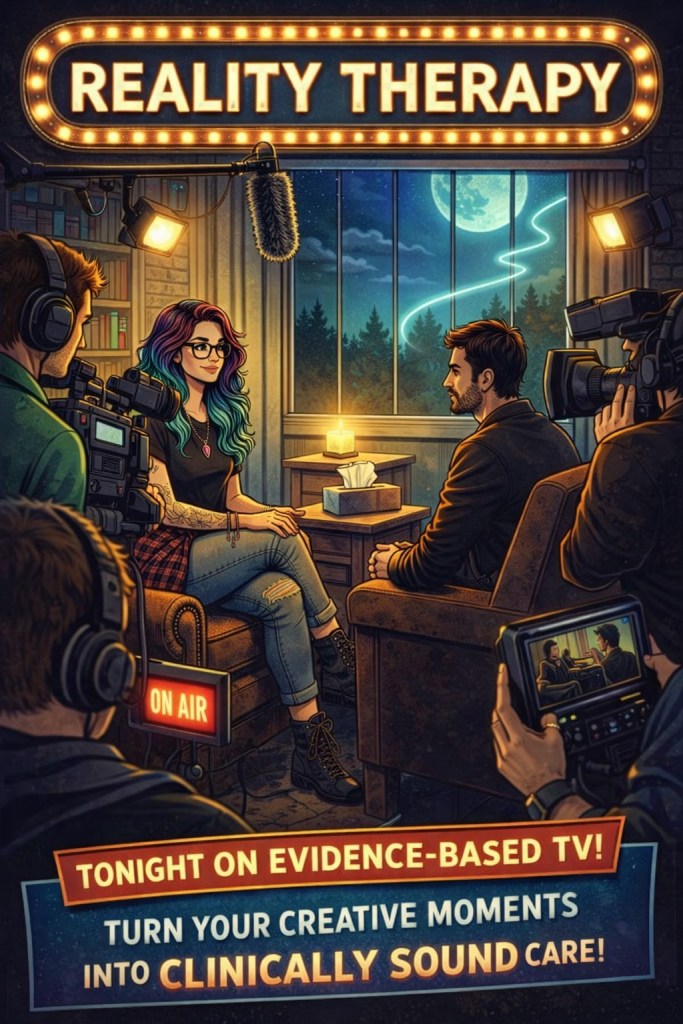
Therapists are magpies. We collect shiny things.
A line from a novel. A moment in a film. A ritual glimpsed on reality TV where two people look each other in the eye and say, “I’m still here.” The world is loud with relational data, and clinicians—by temperament and training—notice patterns everywhere.
That instinct is not the problem.
The problem arrives when inspiration skips a crucial step and walks straight into the therapy room wearing a lab coat it didn’t earn.
In supervision, this tension shows up often: I saw this thing, it seemed powerful, I tried it with a couple. The idea itself may be elegant. Even effective. But without theoretical grounding, it floats untethered—hard to document, difficult to explain to another clinician, and risky when scrutinized by insurance or a licensing board.
This is not a creativity issue.
It’s a clinical translation issue.
⸻
Everyday Life Is the Spark—Theory Is the Structure
Therapy does not originate in sterile environments. It never has. Humans have used story, ritual, symbol, and recommitment long before anyone published a randomized controlled trial. Our nervous systems respond to meaning-making whether it happens in a sacred circle or on late-night television.
Everyday experience is where ideas are born.
But ideas are not interventions until they are theoretically housed—until they can be reasonably understood as serving a psychological, emotional, relational, or nervous-system function within treatment.
A ritual of recommitment at the end of a couples session, for example, may look simple on the surface. Two people pause. They name intention. They step back into the week with something resembling alignment. On its own, it’s just a moment.
Clinically, however, that same moment can be understood as:
- An attachment intervention, reinforcing safety and accessibility after rupture
- A systems-stabilizing ritual, helping the couple exit session without relational whiplash
- A values-based commitment, supporting behavior change despite ongoing distress
- A narrative re-authoring, shifting the story from “we’re stuck” to “we’re practicing”
The ritual doesn’t change.
The clinical justification does.
This is where therapists earn their keep.
⸻
The Question That Changes Everything
In training and supervision, there is one question that separates intuition from clinical judgment:
“What mechanism of change does this target, and from what orientation does it come?”
That question does several things at once.
It forces the therapist to slow down.
It links the intervention to treatment goals.
It creates language that can live in a progress note, a utilization review, or—if needed—a board inquiry.
It clarifies whether the intervention can be reasonably understood as psychotherapy rather than personal belief or preference.
“I saw it on TV” is not a mechanism of change.
“I implemented a structured closing ritual to consolidate repair and reinforce emotional responsiveness between partners” is.
Same behavior. Different professional posture.
⸻
Why This Matters More Than We Want It To
No one becomes a therapist to impress an auditor. Yet the reality of modern practice means our work is regularly evaluated by people who were not in the room and do not speak in metaphor.
Insurance reviews tend to ask:
- Why this intervention?
- How does it relate to the diagnosis and treatment plan?
- What clinical outcome is expected or being monitored?
Licensing boards tend to ask:
- Was this intervention within the professional scope of the license?
- Was it grounded in a recognized clinical orientation or framework?
- Could another clinician reasonably understand the rationale based on the documentation? In other words, oversight bodies are rarely evaluating creativity. They are evaluating clinical reasoning.
Creativity without theory leaves clinicians exposed.
Creativity with theory becomes defensible, ethical, and replicable.
Evidence-based practice does not mean cold or mechanical. It means your imagination knows where it lives—and how to explain itself.
⸻
Teaching This Skill Is a Gift to Pre-Licensed Therapists
When early-career clinicians bring in intuitive ideas, supervision has a choice point.
We can shut it down in the name of rigor.
Or we can elevate it in the name of professional development.
The real work is teaching the translation:
- Where does this idea come from experientially?
- Where does it belong theoretically?
- What clinical target does it support?
- How would you explain it to another clinician—or document it if asked to justify it?
This is how therapists learn to move from doing therapy to thinking clinically.
Not by abandoning creativity—but by giving it a spine.
⸻
A Map for the Magpies
It’s one thing to say, “Ground your creativity in theory.”
It’s another thing to know how to actually do that in real time.
Most inspired ideas don’t arrive with a neat clinical citation attached. They arrive as instinct. As resonance. As that quiet internal nudge that says, There’s something here.
The goal isn’t to shut that down.
The goal is to give it structure.
What follows is not a rigid formula. It’s a lens—a way for pre-licensed therapists (and honestly, all of us) to slow down, translate inspiration into intention, and move from “this felt powerful” to “this is clinically sound.”
Think of it as a map for the magpies.
Not to stop collecting shiny things.
But to help us decide where they belong.
The Nerdie Map: Turning Inspired Ideas Into Evidence-Based Therapy Interventions
(a step-by-step lens for pre-licensed clinicians)
Step 1: Name the Shiny Thing (the idea)
Describe the intervention in plain language—no justification yet.
Example: “I want to end sessions with a brief recommitment ritual.”
Prompt: What is it, exactly? What would a camera see?
Step 2: Identify the Clinical Target (what it’s trying to change)
Choose one primary target (not five).
Common targets:
- Emotional regulation / de-escalation
- Attachment security / repair after rupture
- Communication patterns / conflict cycles
- Values-based behavior / accountability
- Meaning-making / narrative shift
- Boundaries / differentiation
- Somatic settling / co-regulation
Prompt: If this works, what changes between them this week?
Step 3: Choose a Theoretical Home (where it lives)
Pick the framework that best explains why this intervention supports change.
Examples:
- EFT / Attachment-based approaches
- Gottman Method
- Systems theory / structural / Bowen
- ACT (values + committed action)
- CBT / behavioral principles
- Narrative therapy
- Polyvagal-informed work (as a lens, not a modality)
- Psychodynamic / parts work (if relevant)
Prompt: Which orientation would defend this intervention without you needing to “sell it”?
Step 4: State the Mechanism of Change (how it works)
Write one sentence that connects theory to action.
Templates:
- “This supports change by increasing ______, which reduces ______.”
- “This intervention strengthens ______, which helps the couple ______.”
- “This targets ______ by interrupting ______ and reinforcing ______.”
Example: “This supports change by reinforcing repair and responsiveness after conflict, increasing felt safety between sessions.”
Step 5: Check Fit + Risk (when not to use it)
This is where competence becomes real.
Consider:
- Client readiness (too escalated? too avoidant? too unsafe?)
- Contraindications (active coercion, IPV concerns, severe instability, intoxication)
- Cultural fit (does this align with values, faith, identity?)
- Scope and competence (do you have training/supervision support?) Would you feel comfortable explaining this to your board?
- Potential unintended impacts (“performing” reconciliation instead of building it)
Prompt: What’s the scenario where this would backfire?
Step 6: Operationalize It (make it concrete and repeatable)
Define:
- When it happens (end of session, after repair, only when regulated)
- How long it takes (60–120 seconds)
- What the script is (simple, not theatrical)
- What success looks like (one observable indicator)
Mini-script example:
“Before you leave, each of you name one intention for how you want to show up this week—something doable, not dramatic.”
Step 7: Document Like a Clinician (not like a poet)
Tie it to the treatment plan and outcome.
Progress note language template:
- Target: “Focus on de-escalation and repair following conflict.”
- Intervention: “Introduced structured closing ritual to consolidate session gains and support between-session stability.”
- Response: “Couple demonstrated reduced reactivity; each partner articulated one values-based intention.”
- Plan: “Continue ritual; monitor impact on frequency/intensity of escalations.”
Prompt: Could another clinician read your note and understand why this mattered?
Step 8: Review + Refine (make it evidence-based in real time)
Bring it back to supervision:
- What changed?
- What didn’t?
- What needs to be adjusted for fit, risk, or clarity?
- Does the theory still match what’s happening in the room?
Prompt: Is this becoming a ritual of connection—or a ritual of compliance?
“Inspiration is welcome. Clinical reasoning makes it defensible.”
⸻
Inspiration Is Often Vague on Purpose
In clinical practice, ideas rarely arrive with a citation attached.
They emerge from many places at once—trainings, conversations with colleagues, books half-remembered, cultural rituals, spiritual practices, and moments observed in popular media. Sometimes an intervention doesn’t originate as a clear thought at all, but as a felt sense: Something shifted.
In supervision, clinicians may describe an idea without fully tracing its lineage—not out of carelessness, but because inspiration is often cumulative and implicit. The nervous system recognizes what works before the intellect names why.
This is especially true early in a clinician’s development, when intuition is growing faster than theoretical language.
The clinical task is not to interrogate where the idea came from, but to ask a more useful question:
“How do we understand this intervention through a clinical lens?”
That question invites curiosity rather than correction. It shifts the focus from origin stories to professional reasoning.
⸻
Turning Intuition Into Clinical Language
Many effective interventions begin as something a therapist notices rather than something they were explicitly taught.
A pause.
A ritual.
A structured moment of reflection.
A closing practice that helps clients leave session with greater coherence.
None of these are inherently unclinical.
What matters is how the therapist understands and articulates the purpose of the intervention. When intuition is translated into theory, it becomes something that can be documented, explained, and ethically defended.
This translation process is a core developmental task in supervision—not a critique of creativity, but a refinement of it.
⸻
Why This Distinction Protects Everyone
By focusing on clinical grounding rather than anecdotal origin, supervision creates a culture where:
- Pre-licensed clinicians feel encouraged to think creatively
- Ideas are strengthened rather than dismissed
- Interventions become defensible within documentation and review
- The therapist’s professional identity continues to solidify
This approach avoids singling out any one example while still making the standard clear:
Inspiration is welcome.
Justification is required.
⸻
The Nerdie Truth at the Heart of It
Therapy has always lived at the intersection of art and science.
The art notices the ritual on TV and thinks, That matters.
The science asks, Why does it matter, and how do we know?
When those two speak to each other, the work deepens. Clients are safer. Clinicians are protected. And the field retains both its soul and its credibility.
Everything we do is grounded in orientation—not to cage imagination, but to keep it standing when the wind picks up.
That’s not being less creative.
That’s being a professional.
The Meta-Lesson We’re Really Teaching
The deeper teaching here is not about a specific intervention.
It’s about how therapists learn to speak about their work.
Moving from “this felt meaningful” to
“this intervention supports attachment repair, values-based action, or system regulation”
is the shift from helper to clinician.
Supervision exists to support that transition—without embarrassment, without exposure, and without flattening a therapist’s natural creativity.
We are not asking clinicians to stop noticing the world.
We are teaching them how to translate what they notice into language that can stand up in charts, consults, and ethical review—language that protects clients, protects clinicians, and strengthens the integrity of the field itself.
This is how we protect both creativity and credibility.
That’s not calling anyone out.
That’s calling them in.

Written by Jen Hyatt, a licensed psychotherapist at Storm Haven Counseling & Wellness in Temecula, California.
Disclaimer
This article is intended for educational and professional development purposes only. It is not a substitute for formal supervision, legal consultation, or individualized clinical guidance. Licensing laws, scope of practice standards, and documentation requirements vary by state and professional credential. Clinicians are responsible for practicing within their scope, seeking appropriate supervision, and ensuring their interventions align with applicable ethical codes and regulatory standards.




 The Nerdie Therapist
Leave a comment