

On community, reciprocity, insurance, and the strange loneliness of values-based group practice ownership
There was a time when I used to plan gatherings for the therapists at my group practice.
Not meetings. Not trainings. Not another hour spent discussing documentation, insurance authorizations, treatment plans, ethical dilemmas, or whatever fresh bureaucratic poltergeist had wandered into the mental health field that week. I mean actual gatherings, with food, conversation, seasonal things, and reasons to sit together without having to be therapists for a little while.
I imagined these gatherings as small pockets of community inside the machinery of private practice. Therapists spend our working lives helping other people navigate loneliness, relationships, trauma, grief, identity, belonging, and all the strange weather of being human. Surely, I thought, there ought to be somewhere for us to simply exist together too.
Sometimes people came and genuinely seemed glad to be there. They laughed, stayed awhile, talked about things that had absolutely nothing to do with clinical documentation, and found pieces of one another that rarely appeared between sessions. Those evenings mattered to me.
Other times, someone would ask, “Is this paid?”
I want to be careful with what comes next because this is not an essay about employees owing their employer free labor. They do not. The mental health field has a long and rather impressive history of dressing exploitation in respectable clothing and calling it commitment, passion, or being a team player. Therapists should know when something is required, when something is optional, and when something constitutes work for which they should be compensated.
Still, something inside me would sink a little whenever that question came first because I was not trying to schedule another staff meeting. I was trying to build a hearth.
October feels like the right season to admit that I have spent a lot of years tending one. I have gathered the wood, cleared stones, struck matches in bad weather, and guarded tiny flames with both hands. I have tried to create something warm enough that people might gather around it, not because they had to, but because there was something worth gathering around.
Somewhere along the way, I learned one of the lonelier truths of values-based group practice ownership: you can build the hearth, but you cannot make people gather around it.
When I Thought I Was Building More Than a Workplace
When I created Storm Haven Counseling & Wellness in Temecula, California, I never imagined it as a collection of therapists who happened to receive paychecks from the same company. I wanted something more alive than that.
The name itself came from the idea of refuge, a haven from the storms of life. I wanted clients to feel that when they walked through our doors, but I also wanted the people doing the work to experience some version of it. I imagined a place where therapists could be thoughtful, creative, nerdy, neurodivergent, imperfect, curious human beings without sanding themselves down into beige clinical professionalism.
There would be consultation and supervision, of course, because apparently the Board does not accept “we had a really meaningful conversation under the full moon” as adequate clinical oversight. There would also be laughter in hallways, ideas scribbled onto whiteboards, spontaneous conversations, celebrations, collaborations, rituals, ridiculous memes, and occasionally food consumed without anyone discussing medical necessity.
What I wanted was belonging, and I still do.
What I understand differently now is that creating the conditions for community does not mean community will necessarily emerge in the form I imagined. For a while, I orchestrated it. I planned gatherings and made invitations. Sometimes people showed up wholeheartedly, and those evenings became exactly what I hoped they might become. People connected. Friendships formed. The clinical masks loosened for a while.
Other gatherings slowly became smaller. People understandably had children, partners, long drives, plans, exhaustion, responsibilities, and lives beyond Storm Haven. Sometimes attendance felt halfhearted. Occasionally, the first question became whether the gathering counted as paid time.
Eventually, I stopped planning so many of them. There was no ceremonial extinguishing of candles while Stevie Nicks sang somewhere in the distance. I simply became tired of manufacturing opportunities for connection and wondering whether anyone wanted them as much as I did.
“Is This Paid?”
The question deserves more generosity than my disappointed nervous system sometimes wants to give it.
We are living through an important correction in workplace culture. Workers have become increasingly aware of boundaries, unpaid labor, compensation, job expectations, and the ways organizations can quietly consume more than they compensate. That correction matters profoundly in helping professions, where caring has historically been treated as an infinitely renewable resource.
Therapists already perform emotionally demanding work. We move through days filled with trauma, grief, panic, relationships, parenting, identity, suicidality, loss, shame, anger, hopelessness, and every other variety of human ache. Then we document it, attend consultation, complete continuing education, maintain licenses, answer messages, navigate insurance requirements, and occasionally remember that the body needs food and water despite our calendars offering very little evidence of this.
Nobody needs an employer telling them that loving the mission means surrendering the rest of their life to it.
And yet I wonder whether something else gets lost when every workplace interaction must first pass through the question, What am I getting for this?
There is paid work, and there is unpaid work that should never have been unpaid in the first place. There is also a third category that becomes increasingly difficult to name once every interaction inside a workplace is filtered through employment: relationship.
Relationship is the voluntary, unassigned, entirely human impulse to participate because being part of something matters to you. It is showing up because you genuinely want to see the people who will be there. It is texting a colleague after a difficult week, welcoming someone new without waiting for leadership to orchestrate every introduction, bringing something to share because the thought occurred to you and delighted you, or starting the absurd group-chat thread that will make absolutely no sense to anyone six months later.
Community lives there. Employment law cannot manufacture it, and neither can an owner.
I Wish They Could See That I Am Fighting the Same Machine
Maybe part of what hurts beneath the question “Is this paid?” is that I sometimes wish the therapists who work with me could see more clearly that I am working inside many of the same systems they are.
My position within those systems is different, certainly. I am the employer, which means I hold power and responsibilities they do not. My name is attached to the policies, payroll, benefits, contracts, and decisions that affect their work. When something changes, I am often the person communicating it. When the practice cannot provide something someone wants, I am usually standing on the visible side of that limitation.
From where an employee sits, the organization and the owner can understandably blur together into one large creature called management.
From where I sit, however, I am frequently looking at the exact same systems they are and thinking, This is absurd.
I am not standing outside the machinery turning the crank. Much of the time, I am inside it too, trying to keep it from grinding down the people I care about.
I want therapists to earn more. I want them to have good benefits, manageable caseloads, clinical autonomy, meaningful supervision, enough time to do their work well, and lives that do not require recovering from their jobs every weekend. Their work is valuable, and I want that value reflected in the structures surrounding them.
At the same time, I operate inside a healthcare system that regularly places hard limits around what that value can look like financially.
Insurance companies determine reimbursement rates. An insurance-based group practice then has to pay clinicians, payroll taxes, workers’ compensation, administrative staff, billing expenses, credentialing costs, software, rent, utilities, marketing, benefits, supervision, compliance expenses, and all the other infrastructure required to make sure a therapist can walk into an office, see a client, write a note, and receive a paycheck.
The money coming into a group practice is not the same thing as the money sitting around waiting to be divided.
There is a peculiar mythology around group practice ownership that I have written about before: the Scrooge McDuck version of the practice owner, happily backstroking through a vault filled with insurance reimbursements while clinicians upstairs wonder why they cannot have a larger percentage.
I would love to report that owning a group practice comes with a gold-coin swimming pool.
Mostly it comes with spreadsheets.
The Both/And of Therapist Compensation
I have written about the economics of running a group practice before because transparency matters to me. I want therapists to understand what it actually costs to keep a practice running, what happens to revenue after an insurance claim is paid, and why a number that initially looks enormous becomes considerably less impressive after it passes through payroll, taxes, benefits, rent, administration, and the small army of expenses required to keep a healthcare organization alive.
Beneath all that transparency is another hope that is harder for me to admit. I want the people who work with me to know that I am not standing opposite them.
I am not rooting for the insurance company. I am not sitting in my office devising increasingly elaborate ways to give therapists less while hoarding the remainder in my fictional money vault. Much of the time, I am fighting the same machinery from a different seat.
I want therapists to believe me when I say that I have their backs, even when the answer to something they want has to be no, not yet, or I genuinely cannot make these numbers work.
There have been seasons when I responded to that tension by taking less myself. I underpaid myself so that more could remain available to the therapists and the practice because, somewhere in my mind, that felt like what a caring owner should do. Some of that may have been generosity. Some of it was self-sacrifice dressed in a very respectable cardigan.
Eventually, I had to recognize the contradiction. If I believe therapists deserve sustainable careers, adequate compensation, boundaries, and lives outside of work, I cannot build those values on a foundation that requires me to abandon the same things for myself. A humane workplace cannot depend upon one person quietly becoming less human to keep it running.
That is the both/and I keep returning to. I can want therapists to earn more while acknowledging the financial limits of an insurance-based practice. I can advocate fiercely for the people who work here while protecting the sustainability of the organization that employs them. I can care deeply about my therapists and still make decisions they sometimes dislike. I can reject exploitative group practice models without turning exploitation inward and making myself the designated sacrifice.
None of that makes the therapist wrong for wanting more, and it does not make the owner automatically right for saying no. Sometimes two people who fundamentally want good things for one another still find themselves constrained by systems neither of them designed.
The usual story about employers and employees prefers villains because villains are wonderfully efficient. They save us from having to understand reimbursement contracts.
Reality is considerably messier.
Sometimes the therapist is entirely right to want more while the owner sitting across from them genuinely wishes they could provide it. Meanwhile, an insurance company several states away may be determining the size of the pie while the people actually doing the work are left arguing over how its slices should be divided.
That may be one of the cruelties of trying to build a values-based private practice within the larger mental health system. The people standing closest to one another can begin seeing each other as the obstacle when the constraints were built much farther upstream.
I wish my therapists knew how often I am fighting upstream too. Not perfectly or heroically, and certainly not while wearing a cape. Just persistently.
I advocate, negotiate, reconsider systems, look at compensation, think about benefits, study what is changing in our field, build relationships with payers and referral sources, work on credentialing, visibility, marketing, policies, and administrative infrastructure, and carry dozens of things clinicians should not have to think about while sitting with clients.
Much of that work happens precisely because I want therapists at Storm Haven to have a place where they can simply be therapists.
Perhaps part of my grief is realizing that when the machinery works, the machinery becomes invisible. People see the paycheck, but they do not necessarily see the person behind the curtain arguing with the machine.
The Mental Health Field Has Its Own Ghosts
None of this means therapists are wrong to be cautious. Our profession earned some of that caution.
Mental healthcare has historically relied on enormous amounts of uncompensated labor. Interns worked for free. Associates accepted painfully low wages in exchange for hours toward licensure. Clinicians stayed late, answered messages after hours, wrote notes on weekends, attended meetings without pay, purchased their own materials, and quietly absorbed responsibilities that belonged to organizations.
Much of that culture hid beneath noble language: do it for the clients, do it because you are passionate, do it because this is a helping profession.
Nothing haunts a therapist quite like an ethical obligation wearing a nametag that says team spirit.
Of course clinicians learned to ask questions, and practice owners should answer them clearly. Still, we need enough nuance to acknowledge that not every human interaction connected to a workplace is secretly labor wearing a fake mustache.
Sometimes dinner is dinner. Sometimes the holiday gathering really is an invitation. Sometimes somebody creates a beautiful place for people to spend time together simply because they want people to have a beautiful place to spend time together.
That distinction has become surprisingly difficult to discuss without sounding as though we expect employees to embroider company logos onto throw pillows after hours.
The Pendulum Had Good Reasons to Swing
Generational conversations about work often become painfully simplistic. Within approximately four minutes, someone begins complaining that younger generations have no work ethic, and civilization collapses somewhere between an avocado-toast joke and a Facebook comment section.
I do not think that explains what is happening.
Many younger workers watched previous generations devote decades to employers who ultimately treated them as disposable. Others entered adulthood amid student debt, unaffordable housing, rising healthcare costs, economic instability, a pandemic, and a labor market that frequently asked for devotion while offering remarkably little security in return.
Of course people became suspicious of the phrase “work family.” They should have.
Work is not family. A paycheck does not purchase unlimited access to someone’s identity, emotional energy, personal life, or loyalty.
Yet even necessary corrections can cast shadows. When people learn to protect themselves by making work strictly transactional, they may become very skilled at identifying what they owe an organization and less practiced at imagining what they might voluntarily contribute to a community.
That does not make them selfish. It makes them adapted to the world they inherited.
Still, adaptations change what becomes possible inside a workplace.
Community Has Become Harder to Build
The post-pandemic world complicates this further. Many therapists now work at least partly through telehealth, schedules are fuller, commutes are fragmented, and our social lives have become more intentionally scheduled and, in some ways, more fragile. The incidental rituals through which people once built relationships have become less common.
There is no hallway conversation if nobody is in the hallway, no spontaneous lunch when everyone is seeing clients from different locations, and very little lingering after consultation when the next Zoom room opens in four minutes.
Connection increasingly has to be scheduled, and the irony is that the moment you schedule community, it begins looking suspiciously like another meeting.
Therapists are also tired. That matters.
By the end of a week spent being emotionally available to other people, “Come hang out with your coworkers!” may feel less like a delightful invitation and more like somebody has located the final remaining teaspoon of social battery and would now like to borrow it.
I understand that. Understanding it does not completely erase the owner’s loneliness. Both truths can sit beside each other.
Sometimes Someone Really Does Pick Up the Wood
This is also why I cannot tell the story of Storm Haven as though nobody ever cared.
There was a therapist who seemed to understand what I was trying to build almost instinctively. They brought ideas, energy, and that rare quality of looking at the Haven and wondering not only what it already was, but what it might become.
There was a quality of What if we…? in our conversations. We imagined things. We talked about what could grow. They did not need to think exactly as I did or become another version of me. What mattered was simpler and, I have learned, rarer.
They were a builder.
For a while, I felt the relief of another person standing beside me, looking toward the same horizon. I began to believe that perhaps I would no longer have to generate so much of the goodness alone.
Eventually, circumstances made staying unsustainable, and compensation was part of that reality.
I understood.
Understanding did not protect me from grief.
They needed to make decisions about their livelihood. Storm Haven had real financial constraints. The broader systems surrounding both of us had limitations too. None of those truths made them disloyal, and none of them made me uncaring.
There was no villain in the story. I simply could not summon a dramatically higher insurance reimbursement rate through intention-setting, moon water, or aggressive positive thinking.
What I lost was not only a therapist I valued. I lost the experience of believing, for a little while, that perhaps I had found someone who wanted to help build the thing itself.
That grief stayed with me longer than I expected.
Sometimes a person can care deeply and still leave. Someone can believe in what you are building and still need more money. An owner can genuinely want to provide more and still have to look at the numbers. Shared vision does not pay a mortgage, and meaning does not renegotiate an insurance contract.
Sometimes people walk away from something meaningful not because it lacked meaning, but because meaning and sustainability are not always offered together.
That may be one of the harder truths of values-based leadership.
This Is Not an Indictment of My Therapists
I want to be especially careful here because some of the therapists who work at Storm Haven may eventually read this.
This is not a subtweet wearing an SEO title.
There are people at Storm Haven who care deeply about one another and about the practice. Therapists have shown up, brought ideas, supported colleagues, celebrated milestones, consulted with one another, shared resources, made one another laugh, and contributed to the culture in ways I probably do not always see.
Some gatherings have been wonderful. Other seasons have felt quieter. Both are true.
There are also clinicians for whom Storm Haven may primarily be a place where they practice therapy, and that is allowed. Employment does not obligate anyone to make coworkers their closest friends. A job does not need to become someone’s village, and no clinician owes an employer devotion because the employer cares deeply about the mission.
What I am trying to name is something different.
I built Storm Haven from a longing for community, and I am discovering that my longing cannot become everyone else’s responsibility. A therapist can appreciate Storm Haven, do beautiful work there, care about the people around them, and still never experience the practice as part of their deepest community.
That does not mean the Haven failed them.
It may simply mean I was asking one structure to hold more kinds of belonging than any workplace realistically can.
There is wisdom in that realization. There is grief in it too.
Contribution Is Not the Same Thing as Free Labor
Group practice owners need to be able to talk about community without wandering into exploitative territory. Wanting contribution does not mean wanting unpaid work.
If I ask a therapist to complete documentation, treatment planning, assessments, or other routine responsibilities connected to clinical care, that work is part of the compensated clinical work. If I require meetings, mandatory trainings, or other responsibilities outside of that clinical work, those are compensated separately. “But we’re a community!” is not a payroll strategy.
What I miss is something less measurable: generativity.
Generativity is the person who enters a space and wonders what could grow there. It is the therapist who notices an opportunity and says, “I have an idea,” the colleague who sees a gap and begins imagining what might fill it, or the person who dreams up something that could bring people together because they genuinely want to create it.
It is someone walking toward the hearth carrying a log without being asked.
You cannot place that in an employee handbook without killing something essential about it. Generativity has to be voluntary, which is precisely why encountering it feels so precious.
Maybe the Community Exists, and I Am Not Entirely Part of It
Here is the thought I have been sitting with lately, and I am not sure I like it very much: maybe the community exists, but I cannot fully belong to it.
Group practice ownership creates a strange geometry around relationships. I can work hard to be collaborative, transparent, relational, and human, but I am still the person who signs things.
I make employment decisions, know information I cannot share, enforce policies someone occasionally dislikes, and sometimes have to say no. When money stops working, I have to figure out why. When something goes wrong, problems tend to climb uphill until they arrive at my desk and discover there is no further hill.
The therapists within Storm Haven can have relationships with one another that I cannot quite have with them. They can vent about leadership, while unfortunately, I am leadership. They can talk candidly about workplace frustrations without wondering whether the person listening will eventually have to make an employment decision. Their friendships can exist in spaces where the power differential does not follow them into the room.
No amount of warmth completely erases that structural difference.
Perhaps I built a village only to discover that the village founder lives in a slightly peculiar cottage near the edge of town. Everyone knows where to find her when the plumbing breaks.
The Loneliness of Values-Based Group Practice Ownership
There is a kind of loneliness in private group practice ownership that rarely appears in conversations about scaling.
You spend enormous amounts of time thinking about other people’s experiences. Are clinicians getting enough referrals? Is supervision useful? Are policies fair? Can we afford benefits? How can compensation improve? Are clients finding the right therapists? What is happening with insurance? Why did that claim disappear into the abyss? How do we make documentation clinically useful rather than merely bureaucratic? How do we maintain autonomy while satisfying payer requirements? What does the team need? What is changing in the profession? Where are we going next?
When leadership works well, much of that labor becomes invisible.
The lights turn on, payroll arrives, clients find therapists, systems function, and problems get solved before most people know there was a problem. A good deal of group practice ownership consists of making sure nobody notices the bridge needed repairs because you were underneath it at midnight with a flashlight and a wrench.
Eventually, the person holding the flashlight looks around and wonders who is standing beside them.
I do not mean who works for me or who completes the responsibilities attached to their position. I mean who is imagining with me. Who becomes restless when something could be better? Who feels that electric little pull when possibility enters the room? Who sees an empty space beside the hearth and thinks, We could build something there.
That kind of loneliness is difficult to describe because owners occupy a peculiar place within the mental health profession. We are therapists, but we are also employers. We care about accessibility while worrying about reimbursement. We advocate for clinician wellbeing while watching payroll. We want people to rest while simultaneously needing enough completed sessions to keep the organization sustainable.
Leadership continually asks you to hold truths that would prefer not to sit beside each other.
Maybe I Have Been Asking Storm Haven to Be Too Many Things
Lately, I have started wondering whether Storm Haven needs to satisfy every longing that gave birth to it.
Maybe it can be an ethical workplace, a clinically thoughtful group practice, a refuge for clients, a place where therapists receive support, and a meaningful community for some people without becoming every person’s village.
Perhaps it can be a job for someone and something more for someone else, and neither relationship is wrong.
The people who most want to build beside me may not all work at Storm Haven. Some may be other private practice owners sitting alone with spreadsheets at 10:47 p.m., wondering why nobody mentioned existential loneliness in the course about scaling a group practice. Others may gather around The Nerdie Therapist or The Nerdie Matters Collective. There may be clinicians, supervisors, writers, artists, business owners, and wonderfully strange interdisciplinary humans asking the same questions from entirely different rooms.
Perhaps I have been staring so intently at the chairs around one hearth that I have missed the lanterns moving through the woods.
October seems like an appropriate month to notice that.
Not every empty chair means something failed. Sometimes an empty chair simply tells you where your people are not.
You Cannot Make People Love the Thing the Way You Do
Founders eventually have to learn this.
You can explain the vision, protect the values, create good systems, compensate people as fairly as the economics allow, and keep working to make those economics better. You can invite participation, listen when people tell you what they need, change when change is warranted, apologize when you get something wrong, and continue building something you believe matters.
Still, you cannot make another person experience your creation the way you experience it.
To you, the practice may carry years of risk, imagination, sacrifice, financial terror, stubborn hope, sleepless nights, and approximately fourteen thousand encounters with forms that should have been PDFs but somehow required a fax.
To someone else, it may be where they work on Tuesdays.
That does not necessarily mean they are ungrateful. It means they stand in a different relationship to the thing.
I am learning to stop demanding, mostly of myself, that those relationships become identical.
I Am Not Tired of the Vision
The inconvenient part is that I still believe in the hearth.
Cynicism would probably be easier. Cynicism is wonderfully efficient. It requires very little beyond the occasional eye roll and the conviction that nothing will ever change.
Instead, some stubborn part of me continues to believe people need places where they belong, and therapists need them too. We spend enormous portions of our lives witnessing other people’s inner worlds and sometimes leave the office carrying our own experiences in complete silence. We need spaces where nobody expects us to have the answer. We need people with whom we can create, imagine, complain, laugh, rage, grieve, celebrate, and occasionally discuss something that has absolutely nothing to do with attachment theory.
I still want that, and I still want to build it.
What I no longer want is to be the only person generating it.
There is a difference.
Who Is Helping Me Build the Belonging?
For years, I have asked how I can create a place where people feel supported, protected, respected, and invited to belong. Lately, another question has begun following me around: who is helping me build the belonging?
I do not mean because they were assigned to, because it counts toward productivity, or because there is a line on their paycheck labeled community enthusiasm. I mean the people who feel compelled to contribute goodness because generating goodness matters to them.
Maybe other values-based group practice owners carry that question too.
You may have started your practice because you believed therapy could happen differently. Perhaps you wanted clinicians treated better and clients cared for more thoughtfully. Maybe you dreamed of creating something collaborative, relational, equitable, innovative, trauma-informed, neurodivergent-affirming, culturally responsive, creative, or simply more human than the systems you experienced before.
Then you encountered payroll, insurance reimbursement, employment law, healthcare costs, generational changes around work, post-pandemic social life, professional burnout, clinical responsibility, and the economics of mental healthcare.
You also encountered human beings, who remain stubbornly resistant to behaving according to our beautifully laminated organizational values.
Suddenly, you are not only tending a community. You are trying to protect a small ecosystem inside a much larger system that does not necessarily share its values.
That is exhausting work.
The People Carrying Wood
Maybe the next phase of leadership requires a different kind of attention.
Instead of watching every empty chair, I want to notice who arrives. Rather than repeatedly trying to inspire people who do not want to build, I want to become more curious about the people who are already building somewhere.
Who brings ideas? Who becomes animated when possibility enters the conversation? Who asks not only, “What do I get?” but also, “What could we make?”
Those people may work for me, and some will not. A few may walk beside me only temporarily. Someone may leave because the economics cannot sustain the relationship both of us wish could continue.
Their departure does not erase what we built together.
Neither does an empty chair mean the hearth was pointless.
The fire still matters.
If You Are Standing Beside Your Own Hearth
Maybe you are reading this because you recognize yourself somewhere in these pages. You built a group practice because you wanted to do something differently, and perhaps you imagined collaboration, creativity, shared values, community, and people who would become invested not only in their individual work but in what all of you might create together.
Now you are tired.
You have planned the gatherings, sent the invitations, explained the vision, revised policies, increased compensation when you could, created benefits, checked in, asked for feedback, and tried to be transparent about insurance reimbursement and the economics of group practice ownership. Somewhere along the way, you may have started wondering why you seem to care about the whole thing more than anyone else does.
If that is where you are, I do not think the answer is to care less. The work may be learning to distinguish what belongs to you, what belongs to the organization, and what can only ever be offered rather than created on another person’s behalf.
When We Try to Manufacture Community
This may be one of the harder shifts for those of us who are natural builders because when something we value seems absent, our instinct is usually to create more of it. If people seem disconnected, we schedule a gathering. When collaboration feels thin, we build another opportunity for collaboration. If nobody generates ideas, we generate ten. When the room feels quiet, we begin dragging more furniture into it.
Eventually, we may discover that we are doing for the community what therapists sometimes accidentally do for clients: working significantly harder for the change than the people whose change we hope to facilitate.
That realization does not mean closing the door or becoming cynical. Keep creating opportunities when they feel meaningful and sustainable. Make them genuinely optional when they are optional, and compensate people when participation actually belongs to their work. Then allow adults to decide what kind of relationship they want with the practice.
Some people will come while others will not. Someone may surprise you by showing up in ways you never expected, and another person you assumed would love the gathering may spend Saturday night happily at home in pajama pants, blissfully unaware that your charcuterie board exists.
The gathering does not become more communal because the owner exhausts herself convincing everyone to attend.
Separate Employment From Belonging
A group practice can contain several kinds of relationship at once. Some therapists may experience the practice as a meaningful professional community, while others develop close friendships there. A few may become collaborators and generators who begin shaping the culture alongside you. Another therapist may simply think, This is a good place to work.
That can be enough.
There is something strangely liberating about releasing employees from the unspoken responsibility of fulfilling the founder’s original dream. Their job is not to love the practice the way you love it, and our responsibility as owners is not to manufacture devotion. Our responsibility is to provide the employment relationship we promised through fair and transparent compensation structures, clarity, ethical leadership, appropriate support, good systems, clinical autonomy within necessary boundaries, and respect for the human beings doing the work.
Belonging can grow beside that relationship, but it cannot be written into the employment agreement.
Once I stop needing every therapist to become part of the community I originally imagined, I can become more curious about the community that actually exists. It may look different from the one I carried in my head when I founded the practice, but different does not necessarily mean lesser. Sometimes the living thing is more interesting than the blueprint.
Make the Invisible Visible Without Asking for Gratitude
Transparency still matters, particularly for those of us running insurance-based group practices. We can talk honestly about reimbursement, overhead, compensation, benefits, and the economics of mental healthcare. We can explain why certain decisions exist and help clinicians understand the ecosystem they work inside rather than allowing the business side of therapy to remain some mysterious underground chamber where claims disappear and payroll somehow emerges.
Transparency, however, cannot quietly become a request for emotional repayment.
I can explain that I am fighting the same system without needing my therapists to reassure me that I am one of the good group practice owners. I can help someone understand why the practice cannot currently afford something without requiring them to stop wishing it could. There is room for me to say, I wish I could offer more too, while allowing their disappointment to coexist with mine.
Transparency should help people understand the terrain. It should never become an invoice for loyalty.
Sometimes a therapist will understand every financial reality you explain and still decide that another opportunity better meets their needs. They may even care deeply about the practice while making that choice.
It hurts, and it can still be right for them.
When Caring Turns Into Self-Sacrifice
There is a seductive kind of martyrdom available to values-driven leaders. We can become so determined not to resemble exploitative employers that we quietly begin exploiting ourselves instead.
We underpay ourselves, absorb costs, work absurd hours, hold responsibilities that should belong to several people, and make our needs infinitely flexible because somebody else’s always feels more urgent. Eventually, we look up years later wondering why leadership feels so lonely and why resentment has apparently moved into the spare bedroom and started receiving mail there.
Self-sacrifice is not the same thing as values-based leadership.
If I believe the therapists at Storm Haven deserve sustainable careers, adequate rest, fair compensation, and lives that extend beyond their work, those values have to include me. Otherwise, I have not removed exploitation from the ecosystem. I have simply concentrated it in one person and called her the owner.
There will be seasons when leaders choose to take less because the organization needs it. Entrepreneurship contains risk, and temporary sacrifice may sometimes be part of building something new.
The important words are temporary and choice.
A business model that permanently requires the owner to disappear so everyone else can remain comfortable is not a humane business model. It is another version of the same old system wearing nicer clothes, or, given the season, perhaps a sheet with eyeholes.
Grieve the People You Thought Would Build Beside You
Some losses deserve to be understood as losses rather than immediately converted into administrative tasks.
When someone leaves who understood the vision, the grief can extend beyond ordinary turnover. You may have imagined programs together, shared ideas, talked about possibilities, or experienced the rare relief of realizing that another person seemed to carry generative energy rather than waiting for you to produce everything.
Then circumstances change. Money changes. Life changes. They leave.
Leadership creates pressure to translate departure immediately into logistics: transfer the clients, update the website, notify the payers, redistribute responsibilities, remove access, change the directory, and keep moving because the organization cannot simply stop.
Beneath those checkboxes, however, there may be a human being quietly thinking, I thought we were going to build this together.
You do not have to transform someone’s departure into betrayal to acknowledge that it broke your heart. Understanding why someone needed to leave does not require pretending you did not lose something meaningful. Sometimes grief is simply evidence that the relationship and the shared imagining mattered.
Let yourself know that before rushing toward the lesson you are supposed to extract from it.
Then keep building.
Find People Who Understand Leadership From the Inside
Perhaps one of the lonelier mistakes group practice owners make is expecting the people they employ to fully understand the experience of owning the practice. They cannot completely understand it, not because they lack empathy or do not care, but because they occupy a different position within the system.
In the same way that I cannot fully know what it feels like to work for Storm Haven without being responsible for Storm Haven, the therapists who work here cannot entirely know what it feels like to wake up responsible for the survival of the organization itself.
They do not need to carry payroll in their nervous systems, and frankly, I would prefer that they didn’t.
This is why owners need peers.
We need more than networking acquaintances who exchange business cards, compare EHR systems, and discuss conversion rates for forty-five minutes beneath fluorescent conference-room lighting. We need actual people who understand what it feels like to care deeply about clinicians while simultaneously needing those clinicians to meet the requirements that keep a practice sustainable.
Those peers understand that a therapist asking for more can be completely reasonable while the owner saying, I genuinely cannot do that right now, can also be telling the truth. They know what it feels like to stare at reimbursement schedules and wonder how anyone is supposed to build humane mental healthcare from those numbers. They understand the strange moral geometry of wanting everyone to thrive while also being the person who has to make decisions when there is not enough to give everyone everything they need.
Owners need rooms where leadership does not have to be translated before it can be understood.
Perhaps that community cannot entirely exist inside the practice.
Maybe it shouldn’t.
Pay Attention to Generativity
I am increasingly interested in a particular quality that is difficult to measure but easy to recognize when it enters the room: generativity.
Some people naturally generate. They encounter a space and begin imagining what might grow there. A problem becomes a question rather than merely an irritation. Possibility animates them. They contribute ideas without needing every idea to become theirs, and another person’s success does not diminish their own sense of belonging.
You cannot require that quality from employees, nor should you disguise it as an expectation and then become disappointed when people fail to perform it.
You can notice it.
When somebody brings an idea, pay attention. If a therapist becomes excited about creating something, become curious about that energy rather than immediately turning it into another responsibility. When someone contributes voluntarily to the collective life of the practice, make room for what they are generating. If the idea eventually becomes actual work for the organization, compensate the work rather than quietly converting enthusiasm into free labor.
Not every generator needs to become a leader, and not every brilliant idea needs to become a program. Still, those moments may tell you where future collaboration lives.
Instead of spending all your energy convincing reluctant people to pick up wood, begin noticing the people who arrive already carrying some.
Let the Practice Become What It Actually Is
Perhaps the most difficult task for a founder is surrendering the imagined version of the organization long enough to see the living one.
Storm Haven may never become exactly the community I pictured when I began building it. That sentence once felt uncomfortably close to failure, but I am no longer convinced that it is.
Organizations are living systems. Once other people enter them, they stop belonging entirely to the founder’s imagination. Culture emerges through hundreds of small interactions, relationships, conflicts, departures, celebrations, adaptations, private conversations, rituals, mistakes, and choices that no mission statement can fully choreograph.
My responsibility is to tend the conditions in which something healthy can grow. I can protect the values, address harm, maintain structures, invite creativity, compensate labor, and notice what is emerging. Occasionally, I may need to prune something that threatens the larger ecosystem, but I also have to leave enough space for forms of community I did not personally design.
That requires a different kind of leadership than constantly pulling the practice toward the picture inside my head.
It asks me to tend rather than control.
There is humility in that, and perhaps some relief too.
Build More Than One Hearth
A workplace does not have to meet every relational need that inspired us to create it.
If you crave collaborators, find collaborators. When you need people who understand the peculiar emotional weather of leadership, seek other owners who live beneath the same sky. If you want to make art, write, teach, organize, gather, build movements, have strange conversations about the future of psychotherapy, or imagine what mental healthcare might become beyond the limitations of its current systems, perhaps some of those dreams need their own rooms.
That does not mean the practice failed to become a community.
It may simply mean that one hearth was never supposed to warm the entire forest.
For me, some of those other fires may be The Nerdie Therapist. Others may exist within The Nerdie Matters Collective. There may also be communities I have not found yet, filled with practice owners, clinicians, writers, creatives, and builders wandering around with their own armfuls of wood and wondering where everybody else went.
Something about that possibility feels hopeful.
Maybe the people I am looking for are not absent at all. Perhaps they are gathered around fires I have not reached yet.
Let the Question Change
If you are a values-based group practice owner who feels lonely, exhausted, disappointed, or quietly heartbroken that the community you imagined has not materialized exactly as you hoped, perhaps you do not need to abandon the vision. You may simply need to stop measuring its success by how many people gather around one particular fire.
Make employment ethical and compensate work. Be transparent without asking for gratitude in return. Invite community without requiring intimacy, and protect your own sustainability with the same seriousness you bring to everyone else’s. Grieve the people who leave without turning them into villains, while noticing the people who generate something new simply because creating goodness matters to them. Seek peers who understand what leadership costs, and allow your practice to become something alive rather than forcing it to remain faithful to the picture you once held in your imagination.
Then keep watching the woods.
The work was probably never to convince every person who entered the Haven to become a builder. Perhaps the work is to keep tending what matters while becoming better at recognizing the builders when you meet them.
You Can Build the Hearth
So I am not dismantling the hearth. I am learning what belongs to me and what does not.
I can gather the wood, clear the stones, strike the match, and protect the flame when the weather turns. I can place chairs around the fire and make the invitation genuine. I can build an organization that tries, imperfectly and persistently, to honor the humans inside it. I can pay attention to the systems pressing against us, advocate where I have influence, change what I can change, and refuse to confuse my limitations with indifference.
What I cannot do is make anyone sit down, nor can I require another person to love the Haven because I love it. Belonging offered under obligation stops being belonging anyway.
I am still a builder. Some stubborn part of me continues to believe that workplaces can contain humanity without pretending employment is family, that therapists can maintain strong boundaries without abandoning community, and that businesses can pursue sustainability without surrendering the values that made them worth building in the first place.
What has changed is not my belief in the hearth.
I am becoming more honest about how tired I am of carrying all the wood myself, and more curious about what might happen if I stop staring at every empty chair long enough to notice the lanterns moving through the trees.
Perhaps the question for this next season of Storm Haven, and maybe for every values-based group practice owner quietly tending a fire somewhere, is no longer How do I get everyone to gather?
Maybe the better question is:
Who is already walking toward the hearth carrying wood?
Those are the people I want to find.

About the Author
Jennifer Hyatt, LMFT, is a psychotherapist, clinical supervisor, writer, and builder of spaces where psychology, creativity, community, and the beautifully complicated business of being human can meet. She is the founder of Storm Haven Counseling & Wellness, a values-driven group psychotherapy practice in Temecula, California, as well as the creator of The Nerdie Therapist, where she writes and speaks about psychotherapy, clinical leadership, private practice, and the systems surrounding the work.
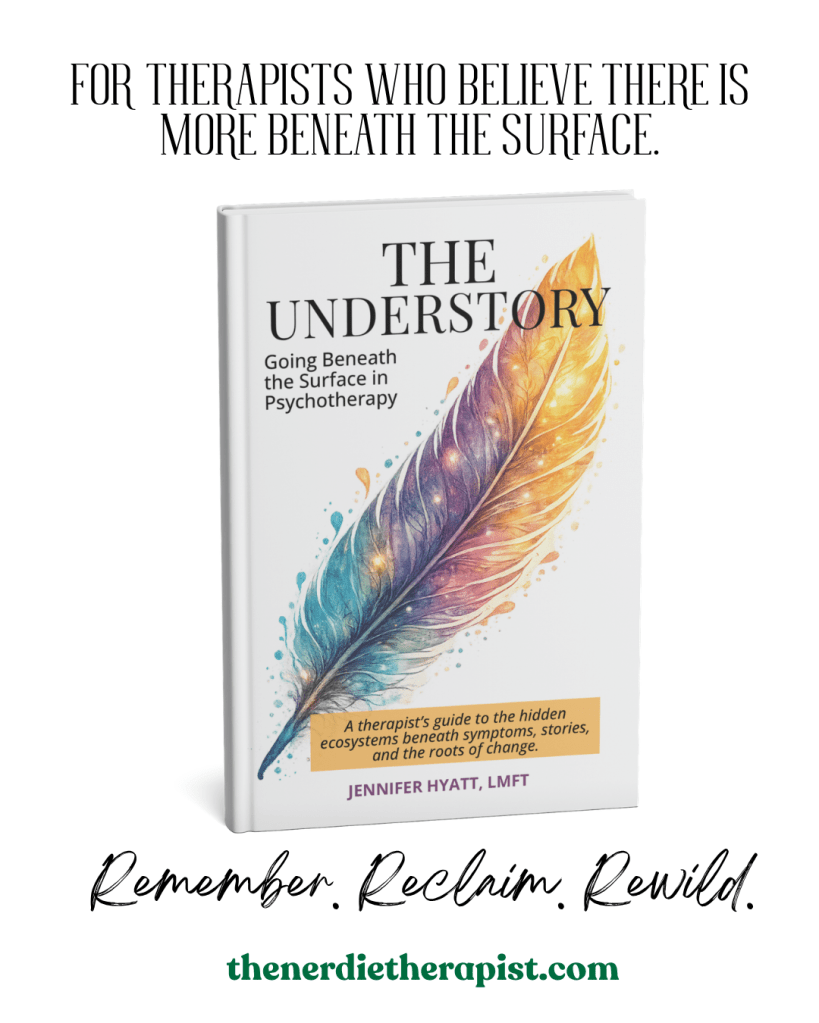
Jennifer is also the founder of The Nerdie Matters Collective, a community created around connection, creativity, and gathering beyond traditional professional spaces. She is the author of The Understory: Going Beneath the Surface in Psychotherapy, a therapist’s guide to the hidden ecosystems beneath symptoms, stories, and the roots of change, and co-creator of Thread & Tether, an archetypal card deck designed by therapists for therapeutic exploration, reflection, storytelling, and meaning-making.
Across these different creations runs a similar thread: Jennifer is interested in what happens when we build places where people are invited not merely to fit in, but to belong, contribute, create, question, and imagine what might grow next. Much of her work lives at the intersections of neurodivergence, depth psychology, nervous system awareness, archetypes, symbolism, relationships, storytelling, and the systems in which therapists and clients are trying to do deeply human work.
Want to Go a Little Deeper?
Some ideas fit neatly into a blog post. Others have roots that keep traveling underground.
The Understory is where I explore what lives beneath the more visible parts of being human: psychology, neurodivergence, relationships, identity, archetypes, symbolism, folklore, pop culture, the nervous system, and the strange and beautiful business of becoming more fully ourselves.
If something here gave you a thread you are not quite ready to put down, come find me in The Understory. We’ll follow it a little farther.
Disclaimer
The information provided in this blog is for educational and informational purposes only and is not intended to serve as medical, mental health, legal, or other professional advice. Reading this article does not establish a therapist-client relationship with The Nerdie Therapist or Storm Haven Counseling & Wellness or any of its providers. Every individual and situation is unique. If you are experiencing mental health concerns, please consult with a qualified mental health professional who can provide individualized assessment and care. If you are experiencing a medical emergency or are in immediate danger, call 911 or go to your nearest emergency department. If you are experiencing thoughts of suicide or are in emotional distress, contact the 988 Suicide & Crisis Lifeline by calling or texting 988.







Leave a comment